
Relative Effects of Mindfulness and Subjective Quality of Life of Medical Trainers and Clients Applying Actor Partner Interdependence Model
Article Sidebar
Main Article Content
Abstract
Background/Objectives: This study applied the Actor Partner Interdependence Model (APIM) to verify the relationship between mindfulness and subjective quality of life in the medical trainer-customer relationship. Methods/Statistical analysis Data were collected from medical trainers and customers in the form of couple data for the application of the interdependence model.
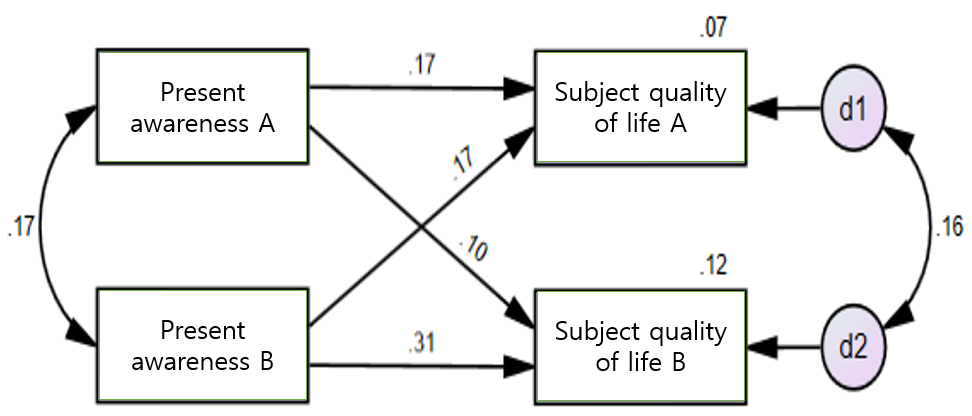
Findings: As a result, the following findings were obtained. First, as a result of verifying the self- and relative effects between the present awareness factors of mindfulness and the subjective quality of life, a significant difference was found in the self- and relative effects of the customers’ subjective quality of life. Second, as a result of verifying the self- and relative effects between the attention factors of mindfulness and the subjective quality of life, a significant difference was found in the self- and relative effects of the medical trainers’ subjective quality of life. Third, as a result of verifying the self- and relative effects between the critical acceptance factors of mindfulness and the subjective quality of life, a significant difference was found in the self- and relative effects of the medical trainers’ subjective quality of life. Fourth, as a result of verifying the self- and relative effects between the decentralized attention factors of mindfulness and the subjective quality of life, a significant difference was found in the self- and relative effects of the medical trainers’ subjective quality of life.